|
"Running is not about winning, it's about guts...
To give anything less than your best is to sacrifice the gift..."
- Steve Prefontaine


Those who saw Steve Prefontaine race, who knew him, who competed against him, called him "Pre" as a sign of respect. He revolutionized his sport with his competitive ferocity and rock star's ability to ignite the crowd. In this country, during his lifetime, he was undefeated at his distance and held all seven American records between 2,000 and 10,000 meters.
He ran one of the more memorable races at the Munich Olympics and was strongly favored to win at the Montreal Games in 1976, but never got the chance. In 1975 Steve Prefontaine was killed in a car accident. He was 24 and had just been recognized as the most popular track athlete in the world.
Blunt, cocky and charismatic, his incessant willingness to push himself to the ultimate limit earned him the enduring respect and affection of runners and sports enthusiasts around the world. He left many of his fellow competitors and fans sharing one common recollection -- where they were and what they were doing when they heard that Pre had died.
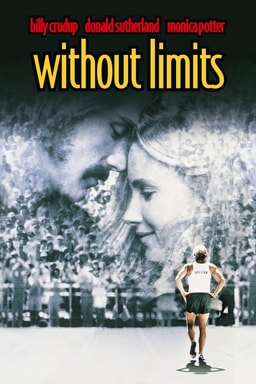
Academy Award-winning filmmaker ROBERT TOWNE directs BILLY CRUDUP and DONALD
SUTHERLAND in "Without Limits," a film about the late Oregon running legend
Steve Prefontaine and his coach, Bill Bowerman. Bowerman helped create a
generation of world-class runners at the University of Oregon and went on to
coach at the Olympics.
An enigmatic, commanding man, revered by his team and respected the world over for his training accomplishments, he became Pre's close friend and mentor. Although taken aback by Prefontaine's unwillingness to substitute strategy for a fervent desire to run at the front of the pack, Bowerman also respected the young track star and came to know him as few others did.
"Without Limits" is the story about two very different men who shared a pure, unadulterated passion for running and a commitment to being the very best they could be. Each rose to greatness; each changed the other's life.
The film is written by Towne and KENNY MOORE, one of Pre's closest friends and a world-class runner and critically lauded writer for Sports Illustrated and other publications. "Without Limits" is produced by TOM CRUISE and PAULA WAGNER. Moore and Jonathan Sanger executive produce. Warner Bros. will distribute "Without Limits" worldwide.
The production obtained Bill Bowerman's full cooperation in making the movie, and Bowerman, who designed and built the first Nike shoe, advised the filmmakers on the details of the running subculture and of Prefontaine's life.
MONICA POTTER also stars in "Without Limits" as Mary Marckx, a woman whose romantic involvement with Pre gave her unusual insight into his complex and uncompromising character.
Working behind the camera is director of photography CONRAD L. HALL, who received an Oscar for "Butch Cassidy and the Sundance Kid," and has earned Academy Award nominations for "Saboteur: Code Name Morituri," "The
Professionals," "In Cold Blood," "The Day of the Locust," "Tequila Sunrise" and
"Searching for Bobby Fischer." Production designer WILLIAM CREBER'S career spans 40 years and includes Academy Award nominations for "The Towering Inferno," "The Poseidon Adventure" and "The Greatest Story Ever Told." Editor CLAIRE SIMPSON received an Oscar for her work on Oliver Stone's "Platoon," and ROBERT LAMBERT previously worked with director Robert Towne on "Personal Best," as well as editing many other distinguished motion pictures. The music supervisor for "Without Limits" is DANNY BRAMSON and the film's score is composed by RANDY MILLER.


"Pre was special," says Academy Award-winning writer and director Robert Towne. "He was one of those extraordinary athletes who comes along every generation or so to shatter the records, shake up the world, die young and leave an inspiring legacy to push beyond the possible burning in our minds, to risk going beyond the limits, beyond the safe edges into the dangerous realm of pain and courage and pure strength of will, that enigmatic place inside each of us where our hopes and dreams live and breathe."
Towne continues, "I'm always attracted to stories about people who are obsessed with their profession, who derive an unusual amount of identity with what they do and how well they do it."
Every script Towne has written, from "Chinatown" to "Shampoo," "The Last Detail" to "Personal Best" to "Tequila Sunrise" and now ""Without Limits," has the profession of the protagonist as the centerpiece of his work.
"In this era of big-money sporting events and athletes who are virtual corporate franchises, it's fascinating to recall a world-class competitor whose career was marked only by his pure love of his sport," says Towne.
Twenty years ago, writer, champion runner and friend of the late Steve Prefontaine Kenny Moore presented Towne with the idea of making a movie about Pre, but Towne was working on another project and unable to address the issue. Three years later when he was in Eugene, Oregon, filming "Personal Best," Towne again explored the topic of a movie about Pre with Moore, who was the track consultant for that film as well as an actor in it.
Finally, in 1994, after many conversations between the two men, Towne convinced Moore to step aside from his association with Sports
Illustrated, collect his thoughts on Pre and write a script for Towne to
direct.
Recalls Moore, "Robert and I happened to be working on a project with Tom
Cruise, who is also a runner and was training for a triathlon at that time.
Robert showed him seven minutes of "Fire on the Track," a documentary about
Steve Prefontaine. Tom immediately loved the story and wanted to see it made
as a dramatic feature."
"Pre is a great American character in a great American story," reflects
Cruise. "And at another level, Pre was also a classic archetypal character,
athlete as hero, with all the physical strengths and psychological weaknesses
that inevitably lead to the most interesting dramatic conflicts. This story
material is rich, multidimensional, complex. It really needs and deserves to
be handled thoughtfully by a top motion picture talent such as Robert Towne."
"Pre was a true free spirit," notes producer Paula Wagner of Cruise/Wagner
Productions. "He's the exception from the crowd as well as from the rules.
He's a rebel. He's cool. He's sexy. He's a distinctively American kind of
hero."
"What inspired me about the project was the ability to learn more about Pre, his fellow competitors and his magnificent coach Bill Bowerman," says Towne. "This was a sport that was certainly, at that time, purist. They were doing it just to run faster, to leap higher and jump farther. It was a sport that pitted Pre not just against his opponents, but against his own needs."
"The rigor with which Robert and I personally approached this story had to do
with getting it right, doing it the way it really was, "says Moore. "This is a
story about a brave guy going out and forcing his moral order into a race by
being a front-runner. He ran so hard that no one had any chance of winning
this race unless they dragged themselves through hell to do it, because Pre was
going to do it."


Once the key filmmakers were in place, the next challenge was to find the actor to play Prefontaine and bring this elusive legend to life.
Says Towne, "We wanted someone who could go the distance, who could take it
all the way...someone who had the same kind of fire inside him as Pre had."
After a rigorous search, Towne met with Billy Crudup in New York City.
"I had heard about Billy's stage work, which had already earned him a lot of
attention," says Towne. "I had arranged to meet him at my hotel. Looking
around the crowded lobby, I spotted Billy sitting in a high-backed
chair against the wall, watching me. He gave me a look and I knew he was Pre.
It was one of the most instantaneous moments in my life."
"The first time I met Billy," says Moore, "I thought I was having dinner with
the same Prefontaine who had lived five years longer and gone to grad school.
He had that same cockiness, that same attitude. The real parallels are the
things he reacts to, the almost instinctive way that he delivers his lines with
the sense of himself. Billy's much more polished than Pre but he's got the
same candor."
Bill Bowerman, Prefontaine's first coach at Oregon and later his Olympic coach, was the second key role to be cast. The part required another actor
with a larger-than-life presence, because Bowerman's own history is a memorable
one. The trainer of an astonishing series of winning runners at the University
of Oregon and the developer of the first Nike running shoe, Bowerman had the
exceptional ability to understand and motive the psyche of a runner. And he
was particularly significant to Pre. As a friend, conscience and mentor,
Bowerman's teaching and presence in Prefontaine's life were critical in shaping
the runner's outlook and success.
The filmmakers were extremely pleased to cast award-winning actor Donald
Sutherland in the role of Bill Bowerman. "Sutherland is one of the great
communicative instruments of our age," says Moore. "He's not immediately a lot
like Bowerman, who intimidated us with how unreadable he was. Bowerman could
advance on you with an expression that you didn't know if he was going to grin,
give you a kiss, compliment you or lift you up off the earth and tell you your
training program was all wrong. One never knew until the last second what was
going to happen."
"What Sutherland has done," says Towne, "is to take the Bowerman essence and run it through the Sutherland machinery."
The story of Steve Prefontaine also had a romantic aspect. Pre was a
charismatic figure who enjoyed the attention he received, and dated many women.
But Mary Marckx was special. When the filmmakers first saw Monica Potter, they
were dazzled by her beauty and vulnerability. "She had the right combination of
naiveté and strength that has helped her embody the character of Mary
Marckx," says Towne.
For Potter, it was a challenge to portray a real-life character who was still living. She spent a lot of time with Mary Marckx, learning about her life and
her relationship with Pre. "She's very strong willed, strong in her beliefs,"
says Potter of Marckx. "Mary really knew Pre. She saw a side of him that not
very many people saw. Mary wrote a book about their relationship, how they
spent time together, her feelings toward his running career and putting track
first instead of her. After reading the manuscript I felt I was able to get
inside her character."
Featured supporting roles in "Without Limits" are played by JEREMY SISTO as
Olympic marathoner Frank Shorter, GABE OLDS as three-miler
Don Kardong, JUDITH IVEY as Barbara Bowerman, DEAN NORRIS as assistant
University of Oregon track coach Bill Dellinger, BILLY BURKE as Olympic
marathoner Kenny Moore, Olympian ADAM SETLIFF as Olympic discus champion Mac
Wilkins, NICHOLAS OLESON as javelin thrower Russ Francis, WILLIAM MAPOTHER as
Bob Peters and MATTHEW LILLARD as miler Roscoe Devine.


The process of working with actors who are also athletes and athletes who have
become actors involved some of the best track advisors in the U.S. -
Kenny Moore, PATRICE DONNELLY, JEFF ATKINSON, JOHN GILLESPIE and JIM JAQUA. Re-creating Prefontaine's races involved research and meticulous choreography, aided by videos of the actual events. The actors and athletes were constantly
maintaining their training and fitness levels during production in order to
enhance their performances.
"The challenges of the actor and the athlete are very similar," says producer
Wagner. "Both professions involve tremendous concentration and focus."
Billy Crudup had been a college athlete and he had a natural quickness on the track. His four months of vigorous training involved the same kind of hard/easy drills that coach Bill Bowerman developed for his own teams.
Says Towne of his star, "He slept with the videos. He watched all the footage
of Pre -- every move, every look to the clock, every arm action."
Knowing that there would never be a sequence that would require the athletes
to run more than 110 to 200 yards for a 5,000 meter race, Crudup's coach for
the film, Patrice Donnelly, trained the actor to run short distances at race
pace. This did not involve a lot of mileage, but rather many repetitive
high-speed intervals. Several times a week Crudup ran 100-200
meter strides with long rests, mimicking what he would be doing during filming.
Says Moore, "When I first ran with him, he was fast already. Crudup loved to
get out and test himself. Patrice would time him at 200 meters. He would run
28.5 and the next week he'd run at 28, then at 27.5 the following week. He got
down to the 26s before shooting started -- he even ran a whole quarter at :59.
Crudup's responses to training were dramatic. That's what talent is -
that potential, that response."
Says Towne, "We wanted to capture the familiarity of athletes who have run
against one another so often that they can actually tell who's near them by the
sound of the way they breathe. Or having the single footstep, the quickness of
it, so that you get to know principal opponents. As a front runner, Pre always
had one ear cocked, so sound is particularly important because he couldn't see
who was behind him. We wanted to take advantage of that, so we used sound as
character. Each footstep connected to a runner would be distinct."


"Without Limits" filmed on location in Oregon, most notably at the University
of Oregon's mythic Hayward Field. There, 24 years after Pre's death, Towne had
the exclusive rights to film those halcyon days known to the local rabid track
fans as "Pre days."
Often referred to as "the Carnegie Hall of track and field," Hayward Field is
where the Prefontaine era continues in the Oregon tradition of distance running
excellence created by legendary coaches Bill Bowerman and Bill Dellinger.
One day during filming at Hayward Field a sudden commotion arose and there was
the legendary Bill Bowerman in the flesh, standing next to Donald Sutherland,
who was portraying him. "That was an exhilarating experience," says producer
Wagner. "Here we were watching someone playing Bowerman and watching the real
Bowerman watching the races that he'd coached years before. He got up and the
crowd in the stands were cheering."
Other filming locations in the Eugene area included Heceta Head Beach, near Florence; Bill Bowerman's home; Laurelwood Golf course, where Pre ran; and the site where Steve Prefontaine died.
After two months in Oregon, the company moved to Los Angeles, where they
filmed the 1972 Munich Olympic sequences at Citrus College in Southern
California. "The infield and track at Citrus," explains executive producer
Jonathan Sanger, "is very similar to the track at the Munich Olympic Stadium."
The Munich sequences involved a different style of running than the races shot
in Eugene. Crudup had to run in groups, in traffic with experienced athletes,
rather than front-running. "There's a lot of jostling that an uneducated eye
would never pick out," says trainer Donnelly. But in order to achieve the
desired level of realism, the filmmakers intercut actual BBC footage from the
Munich Olympics with the footage they shot at Citrus.
Other runners who participated in the filming of the Munich sequences are some
of the top U.S. distance runners: the 1994 National champ at 10,000 meters, TOM
ANSBERRY, plays Emiel Puttemans; eight-time U.S. Cross-Country
champ and Olympian PAT PORTER plays Lasse Viren; 1500 meter Olympic Trials
qualifier STEVE AVE plays Mohamed Gammoudi; and 28-minute
10K runner ASHLEY JOHNSON plays Ian Stewart.


Prefontaine's fights against the Amateur Athletic Union (AAU) were eventually taken up by his contemporaries, who, inspired by his words, ultimately revolutionized amateur athletics in America. During the 1970s, the AAU controlled track and field competition as well as other sports including wrestling and swimming; they determined which athletes could compete against one another and under what conditions. Runners who wanted to arrange their own opportunities to compete against the best felt powerless. Steve Prefontaine, with his relentless drive and will, fought doggedly against the disempowerment of runners and other AAU athletes.
Olympic medalist in swimming and television sports commentator Donna De Verona was both a friend of Pre's and a friend and advisor to Robert Towne. She introduced Towne to Kenny Moore more than two decades ago, and was thrilled when they were finally able to collaborate on "Without Limits." She vividly remembers Pre's involvement in the athletes' rights effort.
"Pre was a firebrand, someone who embodied what's right about sport," recalls De Verona. "He was instrumental in helping the cause of athletes' rights and, because of his outspokenness, he was a lightning rod for the tensions between the AAU and amateur athletes. Others of us who were trying to change AAU regulation were already past our competitive careers, but Pre was still vulnerable to AAU action against him. He took risks for what he believed in and was willing to deal with the retribution."
Explains Towne: "The ramifications of the AAU went beyond the fact that they
were just interfering with Pre's performance. It went to the heart of what's
just and what's unjust, because no matter how fiercely competitive Pre was, he
and his fellow runners loved to race because it was fair. There was no way you
could negotiate a better time -- you had to perform.
"Pre and the rest of the runners of his generation wanted to be tested, wanted
to know the truth. Theirs was not a dance between perception and reality. It
was the least political act that one can imagine -- purely about performance,
not politics, not illusion."
"There were all these forces against the amateur athletes," adds Moore. "Some of them were exploitative, some were part of the leftover amateur establishment that had its exploitative aspect. You really felt in the '70s that you were on the cutting edge of some real social change -- Arthur Ashe; Tommy Smith and John Carlos, who waved their fists in the air in 1968 at the Olympics; Muhammad Ali. Yet there has never been a more powerful voice than Pre's regarding freedom of athletes to go and compete against the finest athletes they could find. It was the Olympic creed -- faster, higher, stronger. And Steve Prefontaine was the ultimate Olympic athlete."
Mary Decker Slaney, a former Olympic runner who met and trained with Pre when both were teenagers, vividly remembers his emotional approach to his sport. "Pre had, among some people, the reputation for being arrogant, but I knew him and that's not the way he seemed to me. He had great passion for running, and he was generous with his time, consideration and support to people who shared that passion. He had tremendous heart.
"I'm glad that this movie was made, because it will introduce Pre to young athletes, and because it shows someone who became a success on a singular, personal level. He was one of the best."
"I run best when I run free."
- Steve Prefontaine
(All photos by Linda R. Chen)

|

|